

Exhibit I · Independent product
Angrove
Public betaon iPhone
A study harness for deep learning that happens to ship with a language model built in. Think Claude Code, but for education. I designed it in Figma and built it in SwiftUI, with the model and search running on your device.
Visit Angrove

The project
I design and build Angrove around a continuing line of study: ask a question, follow its sources, explore a definition, and save an Insight to revisit on a map of related ideas. On-device AI and source retrieval keep inquiry private, with saved personal data encrypted on the device. On Mac, Boards bring conversations, notes, saved Insights, and images into one workspace.
- Platform
- iPhone & Mac
- Built with
- Swift, SwiftUI, Core ML, MiniLM, LiteRT-LM
- My role
- Independent creator: product design, application architecture, implementation, and testing
- Status
- iPhone public beta on TestFlight; native Mac app in development. Captures include development features.
How a study session works
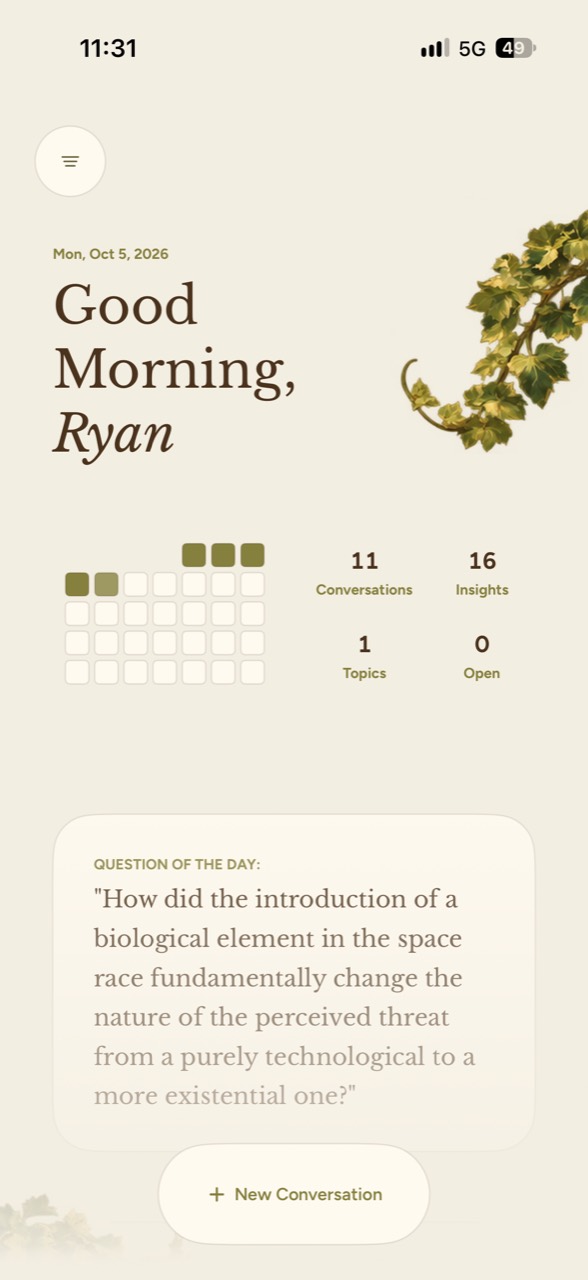
01Start from Home. Recent activity, saved Insights, and a Question of the Day. 
02Ask with sources. Answers show the passages they draw on, such as the Summa Theologica. 
03Open a concept. Underlined terms open a definition in the context of the answer. 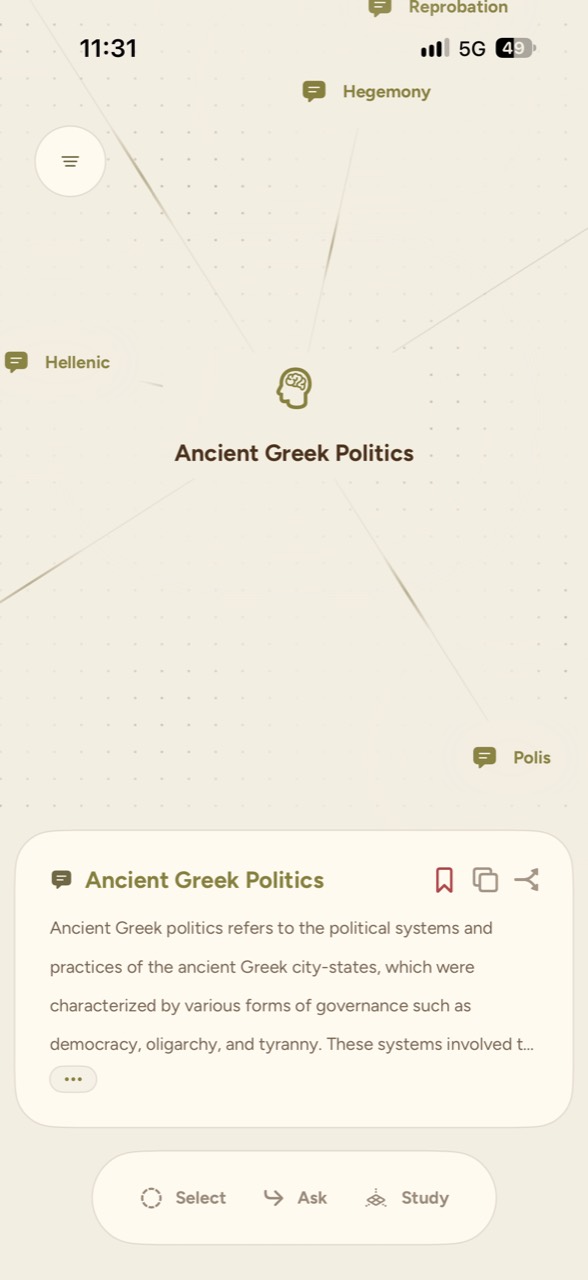
04Keep it. Saved Insights return on a map of related ideas.
Room for a visual reference
An image shares the workspace with the writing. A Board can hold more than a sequence of chat messages, so an argument can take a shape on the page.
Design & engineering
From design to implementation
Shared SwiftUI features, design tokens, retrieval, and persistence serve both native apps; each platform owns navigation and input. Core ML MiniLM embeddings connect saved Insights on an interactive map. AES-256-GCM protects personal stores with Keychain-managed keys. Architecture and tradeoffs.
One runtime, many interactions
Answers, definitions, and tree updates share one LiteRT-LM runtime and a cancellable task queue. Stable conversation and branch IDs let answers finish after navigation without writing into another thread. Regression suites cover late results, retrieval, and storage migration. State and task ownership.
Test the default before choosing it
On two 40-case development sets, thinking on and off each totaled 74/80 objective passes. Simulator CPU median answer times rose from 23.0/23.5s to 43.7/47.6s with thinking, supporting the off default. These are pattern-scored configuration comparisons, not phone speed or general accuracy. Evaluation and limitations.